Case Overview
This case features a specialized manufacturer of explosion-proof LED lighting equipment serving high-risk industrial environments — including petrochemical plants, mining operations, and chemical processing facilities. The company holds a comprehensive portfolio of international explosion-proof certifications and has built a strong reputation in its niche market.
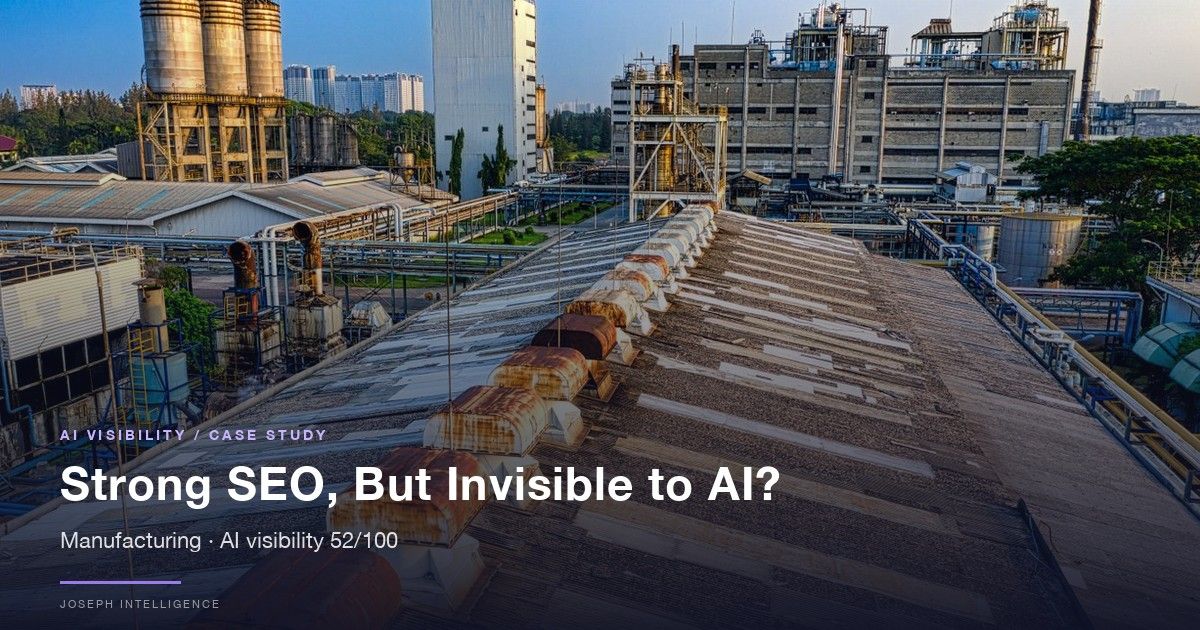
When we ran an AI visibility audit on the company's website, however, we uncovered a striking contradiction. On the traditional side, the site scored an impressive 85/100 in SEO and 73/100 in PageSpeed performance — both solid results. But on the generative AI side, the GEO (Generative Engine Optimization) technical score came in at just 40/100, and the AI visibility score matched it at 40/100.
The overall composite score: 52/100, placing the company in the "moderate" AI visibility tier.
This case is a textbook example of a challenge facing many B2B manufacturers today: exceptional traditional SEO no longer guarantees presence in AI-powered search. You can rank on Google — and still be completely invisible when a procurement engineer asks ChatGPT for supplier recommendations.
Composite Score Breakdown
In the explosion-proof lighting industry, purchasing decisions are heavily driven by technical specifications and certification compliance. AI search tools are rapidly becoming the first stop for procurement engineers evaluating suppliers. Here's how the company's website performed across all three evaluation dimensions:
| Evaluation Dimension | Score | Rating |
|---|---|---|
| AI Brand Mention Rate (GEO Visibility) | 40 / 100 | ⚠️ Needs Improvement |
| GEO Technical Audit | 40 / 100 | ⚠️ Needs Improvement |
| Website Performance (PageSpeed) | 79 / 100 | ✅ Good |
The bottleneck is clear: the company's website infrastructure is solid for traditional search engines, but it lacks the structured data and semantic markup that generative AI platforms need to correctly interpret and cite the company's expertise and product information. Without that layer, even the best-performing website becomes nearly unreadable to AI.
AI Search Visibility Test Results
To gather objective data, we queried three major AI platforms — Claude, ChatGPT, and Gemini — with four queries each, for a total of 12 queries. Each set included both direct brand queries and industry-scenario queries related to explosion-proof LED lighting (e.g., "Which manufacturers produce ATEX-certified explosion-proof LED floodlights?"). Every response was logged for mention status.
Claude
On brand queries, Claude returned what we classify as a "vague mention" — the platform appeared to have some awareness of the company, but provided no specific product details, certifications, or technical specifications. More concerning: of the two industry-scenario queries, one returned a vague mention and the other returned no mention at all. This means that when a procurement engineer asks Claude for explosion-proof lighting suppliers, the company is likely absent from the recommended list.
ChatGPT
ChatGPT performed better on brand queries, returning a "positive mention" — indicating sufficient brand recognition in its training data. However, on both industry-scenario queries, the company received zero mentions. This is a critical gap. When potential buyers search by application need or product specification rather than brand name, the company disappears entirely from ChatGPT's answers.
Gemini
Gemini's results closely mirrored ChatGPT's: a positive mention on brand queries, but complete absence across both industry-scenario queries. Since Gemini excels at synthesizing web content into curated recommendation lists, this result directly reflects the website's insufficient structured data and semantic content — making it difficult for Gemini to categorize the company as an authoritative source in explosion-proof lighting.
Summary: Of 12 total queries, the company received 6 mentions — a surface-level pass rate of 50%. But across all 8 industry-scenario queries, only 2 returned vague mentions and 6 returned nothing. Brand awareness exists, but AI visibility in industry recommendation contexts is nearly zero. That is the core problem this company must address.
Competitive Landscape Analysis
In the industry-scenario queries where the company failed to appear, the AI platforms did return recommended suppliers. The brands cited were predominantly European and North American players — Eaton Crouse-Hinds, Emerson, Larson Electronics — along with a handful of Asian manufacturers that have invested heavily in publicly accessible technical documentation and multilingual content.
This reveals a structural disadvantage that many B2B manufacturers face. AI platforms generating supplier recommendations strongly favor sources with complete structured specification data, clearly documented certifications, and rich application case studies. The technical capabilities of manufacturers in markets like Taiwan often match or exceed those of international brands — but the AI-readable knowledge architecture is significantly less developed. This is both a vulnerability and an opportunity: the window to establish AI visibility leadership in this niche is still open.
GEO Technical Audit
The GEO technical audit evaluates whether a website can be correctly interpreted, indexed, and cited by generative AI platforms. Out of 9 core technical criteria, the company's website passed 5 out of 9 (approximately 56%).
| Technical Item | Status | Priority |
|---|---|---|
| Schema JSON-LD Structured Data | ✗ Not implemented | 🔴 High |
| XML Sitemap | ✓ Implemented | 🟢 — |
| Meta Description | ✗ Not implemented | 🔴 High |
| OG Tags (Open Graph) | ✗ Not implemented | 🟡 Medium |
| Canonical URL | ✗ Not implemented | 🔴 High |
| HTTP/2 | ✓ Enabled | 🟢 — |
| Title Tag | ✓ Implemented | 🟢 — |
| H1 Tag | ✗ Not implemented | 🔴 High |
| HTTPS Secure Connection | ✓ Enabled | 🟢 — |
All four high-priority items failed. The absence of Schema JSON-LD means AI platforms cannot identify product categories, explosion-proof ratings, or certification credentials. Missing meta descriptions leave AI crawlers without a quick summary of page intent. The lack of H1 tags undermines the semantic hierarchy that AI systems rely on to understand page topics. And without canonical URLs, content authority may be diluted across duplicate or near-duplicate pages. These four gaps, taken together, directly explain the GEO technical score of 40/100.
Website Performance
Website performance is a foundational requirement — not just for traditional search rankings, but for AI crawler accessibility. The company's website achieved an overall PageSpeed score of 79/100, with a Performance sub-score of 73/100 and an SEO sub-score of 85/100. The strong SEO sub-score confirms that the traditional SEO groundwork is solid.
The performance score of 73 has meaningful room for improvement. Common bottlenecks for this type of product-heavy industrial website include images not yet converted to WebP format, absence of lazy loading for below-the-fold content, and unminified CSS and JavaScript resources. For a site rich in product photography — as explosion-proof lighting equipment sites typically are — image optimization alone can deliver substantial speed gains. It's worth noting that generative AI crawlers, like traditional search bots, prioritize fast-loading, well-structured pages. Improving performance is not just a user experience investment; it directly strengthens overall AI visibility.
Expert Recommendations
Based on the audit findings, we identified three priority improvement areas — each directly tied to the specific demands of the explosion-proof lighting industry.
Recommendation 1: Implement Structured Data to Make Your Technical Expertise AI-Readable
The complete absence of Schema JSON-LD is the single most direct cause of the company's low AI visibility score. Explosion-proof lighting products carry highly technical specification data — explosion protection categories (Ex d, Ex e, Ex n), certification marks (ATEX, IECEx, UL), and hazardous area zone classifications — that are the core criteria in any procurement decision. These are precisely the data points that AI platforms need structured semantic markup to correctly interpret and cite. Implementing Organization and Product schema markup targeted to this product category is expected to meaningfully increase mention rates across AI platforms.
Recommendation 2: Build an Explosion-Proof Lighting Knowledge Hub to Become an AI Citation Source
The near-total absence from industry-scenario queries stems from a fundamental content gap: the website lacks the depth of authoritative, AI-citable knowledge content that generative platforms look for when composing recommendations. Procurement engineers and safety officers frequently ask questions like "What explosion-proof rating is required for Zone 1 LED lighting?" or "How do I select LED fixtures for a petrochemical facility?" If the company's website answers these questions comprehensively and authoritatively, it becomes a preferred citation source for AI — creating a competitive moat that rivals cannot quickly replicate.
Recommendation 3: Resolve Foundational Technical Gaps to Remove AI Crawler Barriers
The simultaneous absence of H1 tags, meta descriptions, canonical URLs, and OG tags creates compounding confusion for AI crawlers attempting to parse the website. Each missing element is individually suboptimal; together, they may cause AI systems to misidentify the site's topical focus — reducing confidence in citing it as a domain authority. The remediation sequence and technical approach for these items should be planned carefully against the site's existing architecture to avoid unintended side effects.
AI Search Trends in the Explosion-Proof Lighting Industry
Explosion-proof LED lighting is a highly specialized B2B niche, and its procurement process differs fundamentally from general commercial lighting. The decision-makers are typically safety engineers or equipment procurement managers at petrochemical plants, oil refineries, chemical processors, and mining companies. Their primary evaluation criterion is regulatory certification compliance — price and lead time come second.
Historically, these buyers discovered suppliers through industry trade shows, peer referrals, Google searches for certification specifications, and manufacturer catalogs. Over the past two years, however, AI search tools have quietly entered the early stages of this procurement journey. A growing number of engineers now open a conversation with ChatGPT or Gemini before they run a Google search: "Which manufacturers make ATEX-certified explosion-proof LED floodlights?" or "What should I look for when selecting LED lighting for a Zone 1 hazardous area?"
This behavioral shift creates both a threat and an opportunity. The threat: if AI platforms never mention your brand in these conversations, you are eliminated in the first round of supplier screening — and you will never know what opportunities you missed. The opportunity: because explosion-proof lighting is technically complex and the certification landscape is intricate, most manufacturers in this space have not yet built AI-readable knowledge architectures. The company that moves first to establish strong AI visibility in this niche can secure a durable, compounding advantage in AI recommendation lists.
The international dimension amplifies the stakes further. Middle Eastern petrochemical projects, Southeast Asian mining operations, and European chemical plants are all significant export markets for specialized manufacturers — and procurement engineers in these markets are equally reliant on AI search for initial supplier shortlisting. Multilingual structured content and proactive AI visibility strategy will become a competitive weapon for manufacturers pursuing global growth. Within the next 12 to 24 months, AI visibility is likely to shift from a "nice-to-have" differentiator to a baseline requirement for any explosion-proof lighting exporter.
The window to establish first-mover advantage is open now.
Find Out How Your Business Performs in AI Search
If your company operates in explosion-proof lighting, industrial equipment, or any other B2B manufacturing sector — and you're unsure how you appear in ChatGPT, Claude, or Gemini — here are two ways to get started:
🔍 Use our free AI Visibility Check tool to get an initial assessment of your website's AI readiness in under 3 minutes. No technical expertise required.
📋 Or schedule a free results consultation with one of our GEO strategists. We'll walk through your audit data in the context of your specific industry and competitive environment, and give you a prioritized action plan.
For more AI visibility case studies across B2B industries, visit our case study index.
Disclaimer
This article is based on anonymized audit data from an actual engagement. All information that could identify the specific company has been removed. AI platform responses are probabilistic and may vary between query sessions. Technical audit scores and performance metrics represent a point-in-time snapshot and may change as the website evolves.